
What is PlayZebra?
PlayZebra is Zebra, a free daily medical trivia game from The Handover, played at playzebra.io. Every day there is one “shift” of 7 open-answer prompts, 30 seconds each. Any accepted answer scores, but the rarer it is, the more carrots it earns, and your carrots buy an animal from a mule up to a zebra. The game’s page title and FAQ use the phrase “medical Krillion”.
Opens the game in a new tab. This site is a guide, not the game.
PlayZebra at a glance
| Field | Value | Status |
|---|---|---|
| Name | Zebra (people also write PlayZebra or Play Zebra, after the domain) | 1 source · publisher (title, game listing) |
| Type | Daily medical trivia, open answers (not multiple choice) | 1 source · publisher (home, FAQ) |
| Publisher | The Handover | 1 source · publisher pages |
| Domain | playzebra.io, registered 3 November 2026 | 1 source · registrar RDAP |
| Status | BETA | 1 source · home page footer |
| Format | 7 prompts × 30 seconds, the same for every player | 1 source · publisher pages |
| Scoring | 10 / 25 / 50 / 75 / 100 carrots by rarity | 1 source · publisher (home, FAQ) |
| Rewards | Mule 30 · Donkey 80 · Horse 160 · Okapi 250 · Zebra 340 | 1 source · publisher (home, tutorial) |
| Reset | 00:00 Europe/London | 1 source · publisher (FAQ, home) |
| Price | Free daily; The Archive $5 once | 1 source · publisher pages |
| Audience | Doctors and medical students; not aimed at under-16s | 1 source · publisher pages |

Why people call it “medical Krillion”
Krillion is a daily general-knowledge game in which rarer correct answers score more. Zebra uses the same idea for medicine, and the game’s own FAQ answers the question head on:
“That is a useful way to describe it. … Zebra is an independent game and is not affiliated with or endorsed by Krillion.” — Zebra FAQ, question 2
So “medical Krillion” is a fair description of the format, not a statement about who makes it. The page title on playzebra.io even reads “Zebra · Medical Krillion: the daily game for doctors”, which is why search engines connect the two phrases. If you want the original Krillion or other games built the same way, see games like PlayZebra.
Who makes Zebra, and when it started
The publisher is The Handover, which describes itself as a UK medical editorial brand and newsletter for doctors; the game’s privacy notice names it as the data controller and gives [email protected] as the contact. No individual developer is named on the pages reviewed. The domain playzebra.io was registered on 3 November 2026. The public daily list numbers today’s shift #27; counting back one shift a day puts shift #1 on 3 November 2026, which matches every dated shift on record. That launch date is a calculation from the numbering; No launch announcement is linked from the publisher pages reviewed.
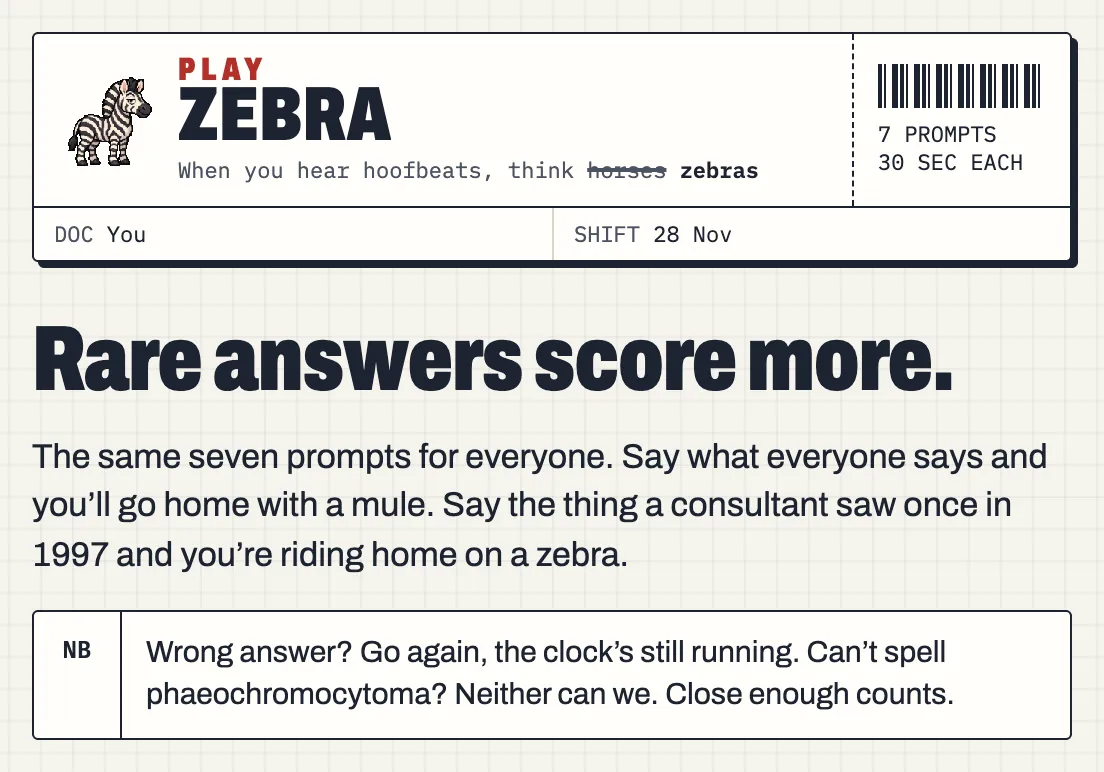
Why the game is called Zebra
Medical students are taught “when you hear hoofbeats, think horses, not zebras”: start with common causes before rare ones. Wikipedia credits the line to
Theodore Woodward of the University of Maryland in the late 1940s. Quote Investigator instead reports that its earliest located print example is from 1962,
and that the Woodward attribution rests on later recollections. The precise origin remains disputed. “Zebra” became slang for a rare or surprising diagnosis. The game flips the
saying: its header reads “When you hear hoofbeats, think horses zebras”, because the rare answer is the one that scores 100 carrots.
Why the names overlap
The game’s page title includes “Medical Krillion”, its FAQ asks “Is Zebra a medical Krillion?”, and its browser address is playzebra.io. Those three public labels explain why Zebra, PlayZebra and medical Krillion can all lead to this game. These references come from one publisher; they do not establish a partnership with Krillion.
Names that are easy to confuse
- ZebraDive (zebradive.io) is a different medical quiz that also calls itself “Zebra”: seven 20-second prompts, scored in micrometres.
- Look-alike domains such as playzebraio.com and zebrakrillion.com are separate sites. See PlayZebra vs Zebra Krillion sites.
- Zebra Medical is a medical-imaging company and zebra.io is a domain for sale; neither is the game.
Next: how a shift works · is it free? · FAQ
Questions
Who made the Zebra medical game?
Zebra is published by The Handover, which describes itself as a UK medical editorial brand and newsletter for doctors. The game’s privacy notice names The Handover as the data controller. No individual developer is named on the public pages.
Is PlayZebra the medical version of Krillion?
The Zebra FAQ says that is “a useful way to describe it”. The same answer says Zebra is an independent game and is not affiliated with or endorsed by Krillion.
Why is the game called Zebra?
From the teaching line “when you hear hoofbeats, think horses, not zebras”: a “zebra” is a rare or surprising diagnosis. In the game, rarer accepted answers earn more carrots, so a zebra is what you aim for.
Is Zebra the same as ZebraDive?
No. ZebraDive at zebradive.io is a separate medical quiz with seven 20-second prompts scored in micrometres. It also calls itself “Zebra”, which is why the two get mixed up.
Sources
- playzebra.io published game script (tier values, animal thresholds and result lines, public tutorial) · checked 28 November 2026
- playzebra.io home page (today’s shift, tier strip, animal ladder, Archive button, BETA footer) · checked 28 November 2026
- playzebra.io FAQ (seven questions: rules, Krillion, scoring, reset, account, friends, medical use) · checked 28 November 2026
- playzebra.io privacy notice (cookies, analytics, payments, retention, age 16+) · checked 28 November 2026
- The Handover home and About page (publisher description, 16,000+ clinicians) · checked 28 November 2026
- whois record for playzebra.io (created 3 Nov 2026, Namecheap) · checked 28 November 2026
- Public daily list read by the playzebra.io home page (shift number, date, specialty labels) · checked 29 November 2026
- Wikipedia: Zebra (medicine), origin of “think horses, not zebras” · checked 28 November 2026
- Quote Investigator: hoofbeats proverb (1962 print evidence; Woodward’s 1940s attribution is retrospective) · checked 28 November 2026
- ZebraDive home page · checked 28 November 2026
Updated 28 November 2026 · This is a game, not clinical guidance.